
Baltimore Rowhouse Plumbing: How the Lines Run and How Leaks Reach Next Door
Rowhouse plumbing in Baltimore has the same parts as any house: a water line from the meter enters the basement, supply pipes rise through the floors, and a drain stack carries waste down to the sewer lateral. The difference is the wall. Baltimore City code defines a rowhouse as joined to its neighbors by a party or shared wall, so water that soaks into that wall can reach the house next door.
Water coming through a shared wall now? Check your own pipes, then knock next door.
Where to look first
- Main valve: where the water line enters the basement.
- Meter: usually in a curb vault, and City equipment.
- Drain stack: the vertical pipe from the roof to the basement drain.
- Cleanout: where the stack meets the basement drain, or outside.
- Outside walls: pipes here need protection from freezing.
- Party walls: a stain here can start on either side.
How do water, drain and sewer lines run through a rowhouse?
Water enters the basement from a meter at the curb, supply pipes rise through the floors, and a drain stack carries waste back down to a basement drain and out through the sewer lateral. Baltimore City DPW says the service line usually enters in the basement or utility area, and City rules place meters at the curb line nearest the water main unless DPW decides otherwise.
| Part | Where to look | Who maintains it |
|---|---|---|
| Water meter | Usually an underground vault at the curb; a DPW page also mentions meters in basements | DPW, including the meter |
| Water service line and main valve | From the meter to the basement or utility area wall; the main valve sits where the line comes in | Owner, from the meter into the house |
| Supply pipes | Up through floors and walls; Philadelphia’s rowhouse manual notes plumbers often cut holes through wood joists to keep pipes hidden | Owner |
| Drain stack | A vertical pipe running from the building drain up through the roof, as the Cast Iron Soil Pipe Institute defines it | Owner |
| Building drain and cleanout | The lowest horizontal drain pipe, in the basement; HUD places cleanouts near where main vertical drains join it | Owner |
| Sewer lateral | From the house to the public sewer | Owner to the property line; DPW from the property line to the main |
| Gutters and downspouts | Roof edge and outside wall | Owner; City code bars adjoining buildings from sharing a downspout |
Start at the water line: locating the main valve in a row home covers gate and ball valves and why the curb vault is off-limits.
The shared wall is what sets a rowhouse apart. Baltimore’s Zoning Code defines a rowhouse as one of three or more single-unit buildings joined by a party or shared wall. The City Building Code does not allow penetrations through party walls, and the plumbing code the City adopts requires each building on a street or alley with a public sewer to have its own sewer connection, though buildings on the same lot may share one. Those rules govern work done under today’s code, so if a pipe in your basement disappears into the party wall, have a plumber trace where it goes.
Digging near that wall has rules too. The City requires written notice to every adjoining owner at least 10 days before applying for a permit to underpin a party wall, and Philadelphia’s city-published rowhouse manual warns that excavating a basement without professional help can undermine the party wall.
Where does rowhouse plumbing fail first?
Check four places first: old galvanized water pipe, old cast iron drains, pipes along outside walls, and the main drain that carries everything to the sewer. Each shows up in HUD, Baltimore City DPW or City plumbing code guidance, and in a row home a leak at any of them sits beside a wall your neighbor shares.
- Galvanized water pipe. HUD’s rehab inspection guideline gives galvanized steel a service life of 20 to 50 years and names rust-colored water, especially from hot lines, and low water pressure as signs of trouble. It warns that galvanized joined to copper or brass without a dielectric coupling can corrode, and advises considering replacement whenever galvanized pipe is exposed; see replacing galvanized supply lines in an older rowhouse.
- Cast iron drains and stacks. HUD lists cast iron waste pipe at 75 to 100 years in a table built largely from industry estimates, and at 75 years in its capital needs tool. Leaks, slow or clogged drains and sewer odors are the signs HUD gives that a drain, waste and vent system needs work. The warning signs of a failing cast iron drain are covered in detail separately.
- Pipes along outside walls. Baltimore City DPW says most water meters and pipes sit in places without heat, like basements or outside walls, and the City plumbing code requires pipes in exterior walls to be protected from freezing. The Institute for Business & Home Safety adds that cracks in an outside wall leave pipes vulnerable to freezing even above 20°F. Before winter, work through the steps for keeping pipes along outside walls from freezing.
- The main building drain and sewer lateral. HUD says a backup at the lowest fixture while several fixtures drain points to a clogged or failing main drain between the house and the public sewer, most often from tree roots. In Baltimore City the owner is responsible for the lateral up to the property line; see repair of a row home’s private sewer lateral.
- Gutters shared by the row. A wet party wall is not always a pipe. Baltimore’s preservation commission (CHAP) warns that heavy rain can overwhelm gutters on rowhouses that have one gutter for an entire roof and back water up under flat roof membranes.
What pipes are in a rowhouse built before 1940?
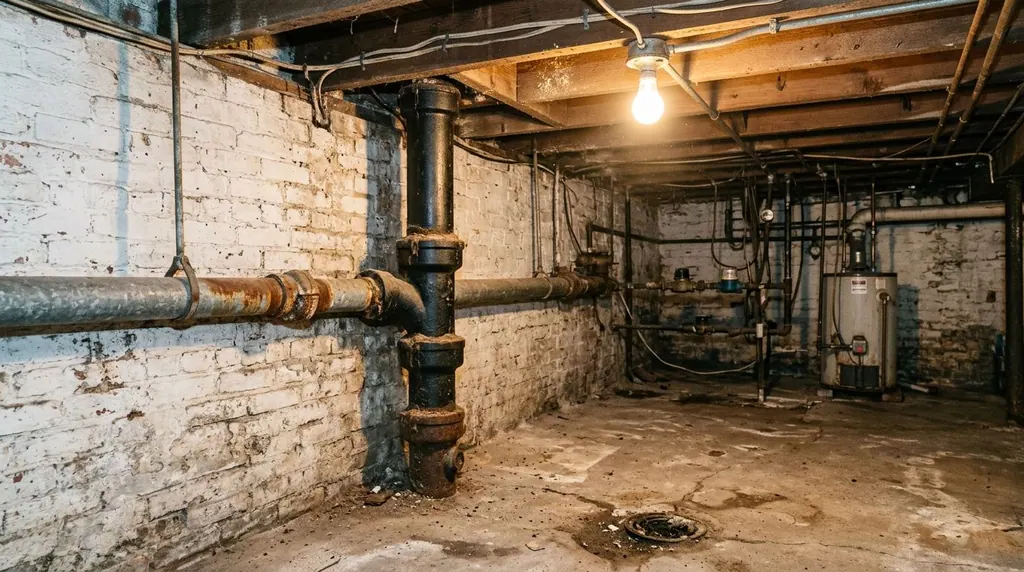
That depends on what earlier owners replaced, so identify the pipe itself. HUD lists cast iron, galvanized steel, lead, copper, brass, clay and plastics among the drain materials found in houses, and says copper piping came into widespread use in most of the country in the 1930s.
Across the 20 Baltimore City ZIP codes in our service-area directory, about 4 in 10 homes were built before 1940 and about half are rowhouses or townhouses, based on U.S. Census Bureau American Community Survey estimates. The directory lists the rowhouse share for every ZIP code we serve.
| Material | Used for | Service life (HUD) | How to recognize it |
|---|---|---|---|
| Galvanized steel | Water supply pipe | 20 to 50 years (2000 guideline); 40 years (capital needs tool) | A magnet sticks easily and the pipe does not scratch easily (EPA) |
| Copper | Water supply pipe, in widespread use from the 1930s | 50 years or more | Penny-colored when new, dull or greenish when old; a magnet does not stick (EPA) |
| Lead | Water service line | Not given; EPA says lead pipes are more likely in homes built before 1986, and Maryland banned installing lead service lines in 1972 | Dull gray and soft; a scratch shows shiny silver and a magnet does not stick (EPA) |
| Cast iron | Drain stacks and building drains; replaced by plastics from the 1970s | 75 to 100 years (industry figures in HUD’s 2000 table); 75 years (capital needs tool) | Bell-and-spigot hub joints were common (HUD); leaks, slow drains and sewer odor signal trouble |
| PVC plastic | Drain pipe; HUD says houses built after 1970 might have plastic drains | 75 years (capital needs tool) | Generally white or gray (EPA) |
HUD’s figures are planning estimates, not a forecast for any single pipe. A water service line of unknown material is worth checking: see checking whether your service line is lead.
Who pays when a leak damages the house next door?
It depends on each owner’s policy and on who is legally responsible. MIA explains that homeowners liability coverage pays for damage to another person’s property that the policyholder is legally liable for, up to the policy limits, and pays for a lawyer if the policyholder is sued. Whether a neighbor is legally responsible is a question the insurance sources here do not settle.
| Situation | Coverage that applies | What the sources say |
|---|---|---|
| Your pipe bursts and damages your house | Your homeowners property coverage | MIA: water damage from a sudden burst is generally covered; repairing or replacing the pipe itself generally is not |
| Your leak damages the house next door | Your liability coverage, if you are legally responsible | MIA: liability coverage pays for damage to others’ property you are legally liable for |
| A neighbor’s leak damages your house | The neighbor’s liability coverage if they are legally responsible; your own policy under its terms | MIA: read your policy to find out what is covered and what is excluded |
| A slow leak inside a wall | Often none | MIA: most policies do not cover damage from a slow leak, regardless of when you discover it; the Insurance Information Institute says lack of maintenance is not covered |
| A pipe that froze in an unheated house | May be denied | MIA and NAIC: a burst caused by failing to keep the home heated may not be covered |
| A renter’s belongings | The renter’s own policy | Insurance Information Institute: a landlord’s policy won’t replace a tenant’s possessions |
| Sewage coming up a floor drain | A sewer backup endorsement, if you bought one | MIA: Maryland law requires insurers to offer it, and most policies will not pay to repair the pipe |
Report the loss to your own insurer either way. For a backup rather than a leak, follow the steps for sewage coming up through a basement drain.
Renting a Baltimore rowhouse: who fixes the plumbing?
In Baltimore City the owner must keep the plumbing in repair, and a tenant who controls the heat must keep the home warm enough to protect the pipes. The City’s Property Maintenance Code makes each owner and operator responsible for maintenance and requires plumbing defects, including deterioration and damage, to be corrected.
- Owner: repairs or replaces defective and damaged items in every unit, according to DHCD, and is responsible for any insanitary condition caused by a sewer back-up or a structural defect.
- Tenant: keeps the unit clean and sanitary, which DHCD says includes keeping plumbing fixtures free of anything that could clog them, keeps the unit warm enough to prevent damage to the plumbing when the tenant controls the heat, and lets the owner in at reasonable times for repairs. DHCD notes an owner may hold a tenant accountable for interior damage caused by negligence.
When a landlord does not fix a serious problem, Baltimore City’s rent escrow law, Public Local Laws § 9-9, lets a tenant go to District Court and pay rent into court. It covers conditions that are a serious threat to life, health or safety, such as a lack of hot or cold running water or of adequate sewage disposal, and says it is not meant for minor code violations. The landlord must first have notice, such as a certified letter or a government violation notice; more than 30 days to make the repair after notice is presumed unreasonable, and the landlord has a defense if the tenant caused the condition or unreasonably refused entry for repairs. Maryland’s statewide law, Real Property § 8-211, lists the same kinds of conditions and applies throughout the State, including Baltimore County.
Rowhouse plumbing questions
Who pays when water from my neighbor’s rowhouse damages my home?
It depends on the policies and on who is legally responsible. The Maryland Insurance Administration explains that a homeowners policy’s liability coverage pays for damage to another person’s property that the policyholder is legally liable for. Report the damage to your own insurer promptly and document it with photos.
Can plumbing pipes run through a party wall in Baltimore City?
The Baltimore City Building Code says penetrations through party walls are not allowed, and the plumbing code the City adopts requires each building on a street or alley with a public sewer to have its own sewer connection. If an old pipe disappears into your party wall, have a plumber trace it.
Does homeowners insurance cover a slow leak inside a wall?
Usually not. The Maryland Insurance Administration says most homeowners policies will not cover damage from a slow leak, regardless of when you discover it, and generally do not pay to repair or replace the pipe itself even when a sudden burst is covered.
What can a Baltimore City tenant do if the landlord won’t fix a plumbing problem?
Under Public Local Laws § 9-9, a tenant can ask the District Court to let rent be paid into court when a serious threat to health or safety, such as no hot or cold running water or no adequate sewage disposal, goes unrepaired after the landlord gets notice. A delay of more than 30 days after notice is presumed unreasonable.
Why do pipes freeze in Baltimore rowhouses?
Baltimore City DPW says most water meters and pipes are in places without heat, like basements or outside walls. The City plumbing code requires pipes in exterior walls to be protected from freezing, and the Institute for Business & Home Safety notes that cracks in an outside wall leave pipes vulnerable to freezing even above 20°F.
Leak inside a rowhouse wall?
Once the source is on your side of the party wall, the damaged section of pipe has to be found and replaced, whether it is a corroded galvanized supply line or a cracked drain. Speedy Plumbing Baltimore handles that work; see our emergency repair for leaks inside rowhouse walls page, or fixing a cracked or leaking cast iron stack when the drain is the problem.
Sources
Checked 2026-09-13. Plumbing and safety guidance changes; follow your utility’s and insurer’s current instructions.
- Baltimore City Code, Art. 32 (Zoning) § 1-305: definition of Dwelling: Rowhouse
- Baltimore City Building, Fire, and Related Codes (2024 Edition), Part II Building Code: §§ 706.9, 1502.5, 1804.2.2
- Baltimore City Building, Fire, and Related Codes (2024 Edition), Part VI Plumbing Code: § 305.4.1
- Baltimore City Building, Fire, and Related Codes (2024 Edition), Part VII Property Maintenance Code
- UpCodes: Baltimore Plumbing Code 2021, Chapter 7, § 701.3 Separate Sewer Connection
- Baltimore City DHCD: Owner and Tenant Responsibilities (updated August 2025)
- Baltimore City DHCD: Property Violations FAQs (updated April 2025)
- Code of Public Local Laws of Baltimore City § 9-9 (rent escrow)
- Maryland Code, Real Property § 8-211 (rent escrow)
- Baltimore City CHAP: Historic Preservation Design Guidelines (updated July 2022, PDF)
- City of Philadelphia: Philadelphia Rowhouse Manual, A Practical Guide for Homeowners (2008, PDF)
- Baltimore City DPW: DPW Wants to Know the Material of Your Water Service Line
- Baltimore City DPW: The Rules and Regulations for Water and Wastewater (PDF)
- Baltimore City DPW: Cold Weather Tips (January 2026)
- Baltimore City DPW: Protecting Your Water Service
- Baltimore City DPW: Sanitary Sewer Decree FAQ
- Baltimore City DPW: Baltimore City and County Form Service Line Partnership
- Cast Iron Soil Pipe Institute: Cast Iron Soil Pipe and Fittings Handbook (2006 printing, PDF)
- HUD: Residential Rehabilitation Inspection Guideline (February 2000, PDF)
- HUD: The Rehab Guide, Volume 8: HVAC/Plumbing (August 1999, PDF)
- HUD: CNA e-Tool Estimated Useful Life Table (2017, PDF, archived July 2026)
- EPA: Know Your Plumbing fact sheet (January 2025, PDF)
- EPA: Basic Information about Lead in Drinking Water
- IBHS: Freezing and Bursting Pipes (hosted by City of Paola, KS)
- NAIC: Post-Disaster Claims Guide (PDF)
- NAIC: Will My Homeowners Insurance Policy Cover Water Damage From a Burst Pipe? (February 2024)
- Maryland Insurance Administration: A Consumer Guide to Homeowners Insurance (PDF, archived June 2026)
- Maryland Insurance Administration: Water Damage, Will My Homeowners Insurance Policy Cover It? (April 2019, PDF, archived December 2025)
- Maryland Insurance Administration: Coverage for Water that Backs Up Through Sewers or Drains (archived April 2026)
- Insurance Information Institute: Which disasters are covered by homeowners insurance?
- Insurance Information Institute: Renters insurance
- EPA: A Brief Guide to Mold, Moisture and Your Home
- CDC: Guidelines for Cleaning Safely After a Disaster
Water coming through a shared wall?
Call Speedy Plumbing Baltimore to find the leak and fix the pipe on your side of the wall. The line is answered 24 hours a day.
Call (716) 328-9097